Sustainable UHS
Why sustainability matters
Climate change is the greatest public health challenge of our time. As one of the largest employers in Southampton, and with an energy use comparable to all the households in Winchester combined, UHS has a significant influence on the health of our local population and environment. By reducing our environmental footprint, we can help prevent illness, improve health outcomes and create a more resilient NHS.
Since 2022, we’ve already reduced high-carbon anaesthetic gases, advanced digital care, and secured major investment in solar energy, LED lighting and other low-carbon improvements. This updated plan builds on those foundations with clear priorities across clinical care, travel, estates, medicines, procurement, digital services, food, green space and climate adaptation.
Our updated Green Plan
Our revised Green Plan sets out how University Hospital Southampton will reduce its environmental impact and support the NHS ambition to reach net zero. Building on the progress made since our first plan in 2022, it outlines the priorities and actions we will take over the next three years to deliver sustainable healthcare for our patients, staff and communities.
Read the full revised Green Plan here
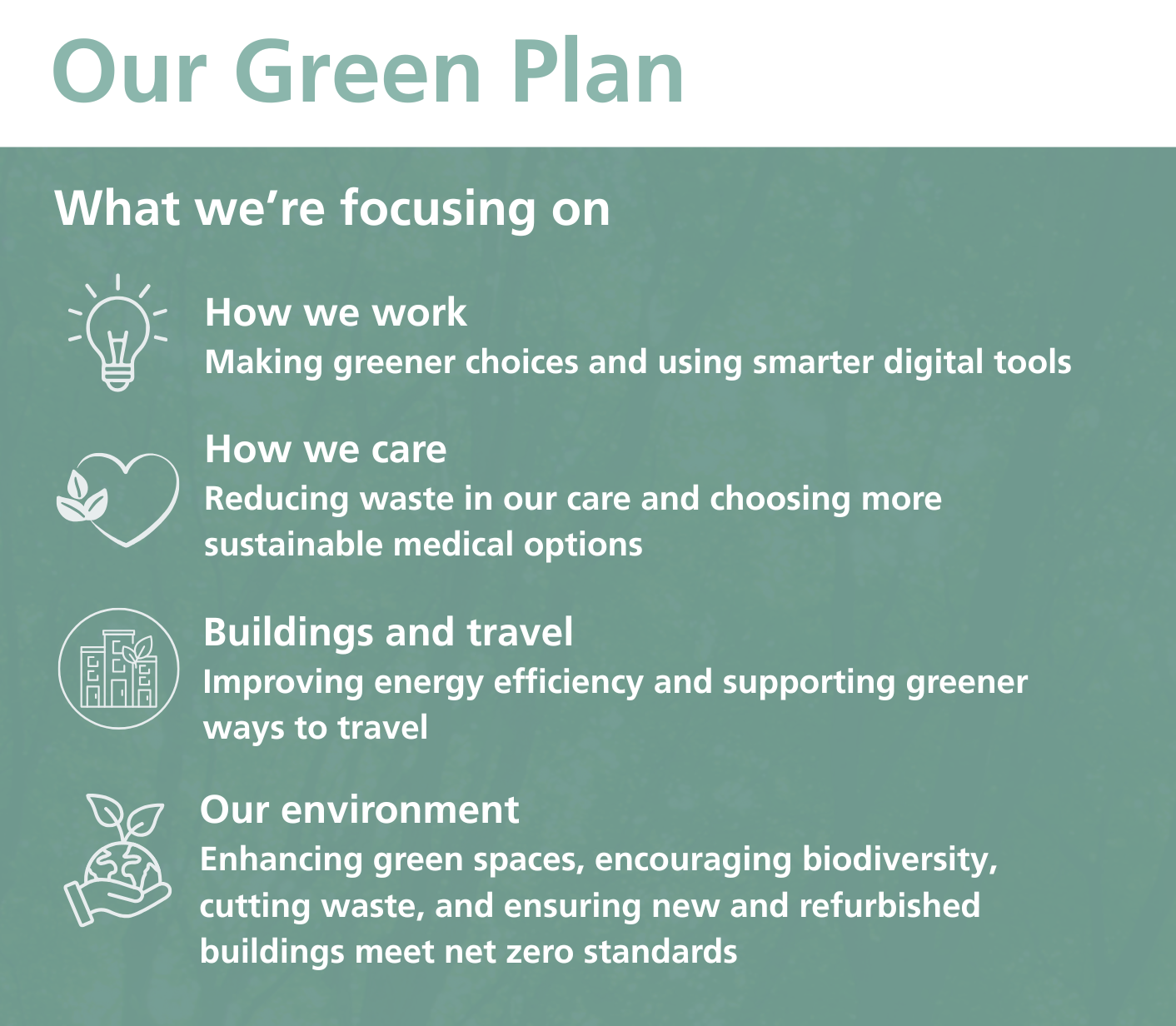
There are 10 areas that we will be focusing on to make UHS more sustainable in everything that we do. We will update the sections so keep checking back for updates and ways you can get involved to support UHS in being a sustainable organisation that is fit for the future.
Our people are at the heart of the NHS's journey to net zero. By engaging, informing and equipping our 1.3 million staff with the knowledge and skills they need, we can drive meaningful change across the health service and support the transition to a greener NHS.
The Greener NHS programme works closely with regional leaders across England to help deliver net zero commitments and share best practice. Collaboration at every level of the NHS is essential to ensuring sustainable solutions are implemented effectively and consistently.
By building sustainability into everyday decision-making, policies and guidance, we can empower our workforce to make a difference. Together, we will scale up successful initiatives, embed greener ways of working and create a more sustainable healthcare system for future generations.
Delivering high-quality, sustainable healthcare means considering environmental impact alongside patient outcomes. The NHS Long Term Plan highlights the need to transform the way care is provided, and reducing carbon emissions is an important part of that journey.
Many of the approaches that improve patient experience and clinical outcomes can also help reduce the carbon footprint of healthcare services, including:
- Providing care closer to home and in the most appropriate setting
- Detecting, diagnosing and treating conditions earlier
- Embedding best clinical practice across services
- Supporting long-term health and prevention
- Making greater use of digital technology and innovation
These improvements can reduce unnecessary travel for patients and staff, lower demand on emergency and outpatient services, decrease hospital stays, and reduce the need for resource-intensive treatments and medicines. As new models of care are developed, a net zero framework will help assess and maximise the associated carbon savings, ensuring sustainability is embedded into the future of healthcare delivery.
Digital transformation is playing a key role in helping the NHS deliver high-quality, sustainable healthcare while reducing its environmental impact. By embracing digital technologies and innovative ways of working, the NHS can improve efficiency, enhance patient experience and support its journey towards net zero.
Digital solutions such as virtual consultations, remote patient monitoring, electronic records and data-driven decision-making can help reduce unnecessary travel, streamline clinical processes and make better use of resources. These approaches not only improve access to care but also contribute to lower carbon emissions across the healthcare system.
Key benefits of digital transformation for sustainability include:
- Reducing patient and staff travel through virtual and remote care
- Minimising paper use through digital records and workflows
- Improving energy efficiency through smart building and infrastructure management
- Supporting data-driven decisions that optimise resources and reduce waste
- Enabling preventative and personalised care through digital tools and analytics
As digital technologies continue to evolve, they will help the NHS deliver greener, more efficient services while maintaining the highest standards of patient care. By embedding sustainability into digital programmes and innovation projects, the NHS can create lasting environmental benefits alongside better health outcomes for patients and communities.
Our travel plan encourages staff and visitors to use more sustainable forms of transport. As the sustainable travel plan evolves, the Trust recognises that it may be appropriate to consider the adoption of further objectives and revisions to targets to ensure that the plan meets future travel demands and expectations.
Please take some time to read this travel plan, and in doing so appreciate what it is looking to achieve, what sustainable transport choices you can make and how these will improve the environment for everyone.
The NHS estate, including hospitals, community healthcare facilities, primary care buildings and privately financed sites, is responsible for around 15% of the NHS's total carbon emissions.
To achieve a net zero health service, it is essential that all new healthcare buildings are designed to meet net zero standards. At the same time, improvements must be made across the existing estate to reduce energy use and carbon emissions.
There are many opportunities to make NHS buildings more sustainable. These include upgrading heating, ventilation and hot water systems, improving insulation and building fabric, installing energy-efficient LED lighting, and modernising air conditioning and cooling equipment. Together, these measures can help create healthier, more efficient buildings while supporting the NHS's journey to net zero.
You can read our UHS decarbonisation programme - making our hospitals more sustainable here.
Green spaces and biodiversity are essential to creating healthier, more sustainable healthcare environments. By protecting and enhancing natural habitats across NHS sites, we can support local wildlife, improve air quality and create welcoming spaces that benefit patients, staff and visitors alike.
Well-designed green spaces can play an important role in health and wellbeing. Access to nature has been shown to support physical and mental health, aid recovery, reduce stress and provide opportunities for relaxation and outdoor activity. At the same time, biodiverse landscapes help strengthen resilience to climate change by supporting natural ecosystems, managing surface water and reducing the impacts of extreme weather.
Key opportunities to enhance green spaces and biodiversity include:
- Creating and restoring habitats for local wildlife
- Increasing tree planting and native vegetation
- Developing pollinator-friendly gardens and green corridors
- Improving sustainable drainage and natural flood management
- Enhancing outdoor spaces for staff, patients and communities
- Reducing the use of pesticides and promoting nature-positive land management
By integrating biodiversity into estate planning and development projects, the NHS can deliver environmental benefits alongside improvements in health and wellbeing. Investing in green infrastructure helps create resilient healthcare environments that support both people and nature, contributing to a greener and more sustainable future.
Medicines are responsible for a significant proportion of the NHS's carbon footprint, accounting for around a quarter of emissions across the health service. A small number of medicines contribute disproportionately to these emissions, with anaesthetic gases, nitrous oxide and inhalers representing some of the largest sources.
The NHS is working with patients, clinicians and industry partners to reduce the environmental impact of medicines while maintaining safe, effective and high-quality care. This includes reducing unnecessary waste, ensuring patients have access to the most appropriate treatments, and supporting informed, shared decision-making between healthcare professionals and patients.
Key areas of focus include:
- Reducing medicine waste through efficient prescribing and disposal practices
- Supporting the use of lower-carbon treatment options where clinically appropriate
- Optimising the use of inhalers and anaesthetic gases
- Improving supply chain sustainability
- Encouraging shared decision-making to achieve the best outcomes for patients and the environment
By taking a sustainable approach to medicines management, the NHS can reduce emissions, improve resource efficiency and continue delivering excellent patient care while supporting its journey towards net zero.
The NHS relies on a vast network of suppliers to provide everything from medical equipment and food to office products and support services. Together, the non-medicines supply chain accounts for a significant proportion of the NHS's carbon footprint, making it a key area for reducing emissions and driving sustainable change.
While the NHS does not directly control emissions generated by suppliers, it can use its purchasing power and influence to encourage more sustainable products, services and business practices throughout the supply chain.
Key areas of focus include:
- Using resources, equipment and supplies more efficiently
- Supporting low-carbon products and innovative sustainable solutions
- Reducing waste and promoting circular economy principles
- Working with suppliers to measure, manage and reduce their carbon emissions
- Embedding sustainability and net zero requirements into procurement processes
The NHS is committed to creating a greener, more resilient supply chain. By working collaboratively with suppliers and partners, we can reduce environmental impacts while delivering high-quality, value-for-money services. As part of this commitment, suppliers will be expected to demonstrate progress towards net zero, helping to ensure sustainability is embedded across the healthcare system and supporting the NHS's long-term environmental goals.
Food and catering services play an important role in the NHS's sustainability journey. The food we produce, purchase and consume has an environmental impact, and making healthier, more sustainable choices can help reduce carbon emissions while supporting improved health and wellbeing.
The NHS is working to promote nutritious, balanced meals that are good for both people and the planet. By increasing access to healthy, sustainably sourced food and reducing reliance on highly processed products, healthcare organisations can support better patient outcomes while lowering their environmental footprint.
Key areas of focus include:
- Providing healthy, nutritious and sustainable food options
- Increasing the use of locally and responsibly sourced produce where possible
- Reducing food waste across NHS sites
- Lowering emissions associated with food production, transport and storage
- Supporting sustainable procurement practices throughout the food supply chain
- Encouraging environmentally responsible catering operations
Through collaboration with catering teams, dietitians, suppliers and national food programmes, the NHS is working to create a food system that benefits patients, staff, visitors and the environment. By making sustainable food choices a central part of healthcare provision, the NHS can reduce emissions, support local economies and contribute to a healthier future for all.
As the impacts of climate change become more frequent and severe, the NHS must not only reduce its carbon emissions but also adapt its buildings, services and infrastructure to remain resilient. Rising temperatures, extreme weather events, flooding and poor air quality can all affect the delivery of healthcare and the health of the communities we serve. [england.nhs.uk]
Climate adaptation is about preparing for these challenges and ensuring that NHS services can continue to operate safely and effectively, both now and in the future. By building resilience into our estates, operations and planning processes, we can protect patients, staff and essential services from the impacts of a changing climate. [england.nhs.uk]
Key areas of focus include:
- Increasing resilience to heatwaves, flooding and extreme weather
- Protecting critical infrastructure, including energy, water and transport systems
- Reducing overheating risks within healthcare buildings
- Improving emergency preparedness and business continuity planning
- Assessing and managing climate-related risks across NHS organisations
- Creating safer and more comfortable environments for patients and staff
The NHS is developing tools, guidance and best practice to help organisations understand climate risks and identify appropriate adaptation measures. By embedding climate resilience into decision-making and long-term planning, we can ensure healthcare services remain effective, sustainable and responsive in the face of future environmental challenges. [england.nhs.uk]
Adapting to climate change is a vital part of creating a greener NHS, helping to safeguard health services, strengthen community resilience and support better outcomes for future generations.