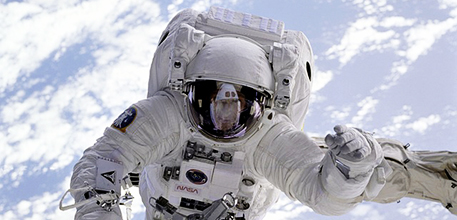
Our Babelfish device was one of the experiments carried out during Tim Peake’s time on the ISS, where it was used to track how well astronauts were adapting to the low gravity conditions.
Keeping safe in space
Now that he has returned back to Earth, Tim Peake will be going through a period of adaptation as his body gradually adjusts to the pull of gravity once again.
Among other changes, he may experience problems with his vision, thought to be the result of high pressure within the skull caused the low gravity conditions.
While he was up there, our Babelfish device was trialled by NASA and the UK Space Agency as a new way to check astronauts’ intracranial pressure doesn’t get too high while they are in space.
Tim has been photographed holding the device on the International Space Station (ISS) – a British invention held by the UK’s first European Space Agency astronaut.
Following in astronauts’ footsteps
High pressure inside the skull is not just a problem for astronauts; it can also have very serious consequences here on Earth.
Caused by a head injury, leaking blood vessels or infection within the brain, it can lead to headaches and progress to confusion, coma and death if left to rise unchecked. Currently the only reliable way to measure this pressure is to operate, drilling a hole through the skull through which a pressure probe can be placed into the brain.
We are running a trial, known as the Babelfish study, of the same headphone-like device used in space. This devise calculates the pressure within your skull by measuring the movements of the eardrum, and could make checking the pressure in your skull as safe, quick and easy as having your blood pressure checked.
Posted on Friday 8 July 2016