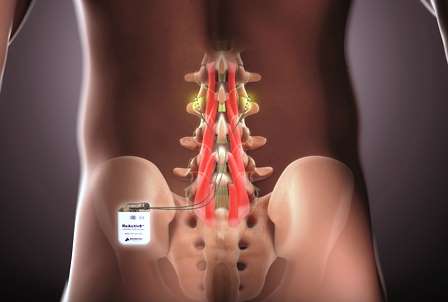
Neurosurgeons in Southampton are among the first in the world to participate in a post market clinical study of a surgically-implanted electronic device for the treatment of chronic lower back pain.
Mr Girish Vajramani, a functional neurosurgeon at the University Hospital Southampton NHS Foundation Trust, and his team are participating in the international multi-centre study. The device is already approved in Europe and received CE Mark based on data from the ReActiv8-A study. The investigators expect that the additional data from the post market clinical study will provide compelling evidence that confirms the safety and performance of ReActiv8 as reported in the ReActiv8-A study. The device uses electrical signals to overcome impaired control of the key stabilising muscles of the lower back to improve stability and reduce symptoms.
Life-limiting pain
Around two thirds of adults struggle with lower back pain at some point in their lives. In most cases, the pain isn’t caused by anything serious and will usually get better within a few weeks but for 7% of sufferers it develops into a chronic condition that can affect day-to-day life and activities.
Lower back pain often begins as a simple strain or sprain in one of the spinal joints. To avoid pain, the central nervous system automatically reduces muscle activation around the painful joint.
Although this is helpful short-term, over time, reduced muscle activity worsens the stability of the lower back which can cause segments of the spine to move more easily into painful positions. If left untreated it can lead to an ongoing cycle of lower back pain and muscle weakening.
Breaking the cycle
Used as a last resort after physiotherapy, medication and other treatments have been tried, the ReActiv8 device is designed to relieve chronic back pain by ‘awakening’ the muscles around the painful joint.
The small device, which is about the size of a matchbox, is placed into the lower back just below the skin via a minor surgical procedure and two thin wires are placed either side of the spine adjacent to the nerves that control the muscles.
“Similar to expert guided exercises that aim to restores muscle control, electrical stimulation is delivered twice a day for about 30 minutes at a time,” explains Mr Vajramani.
“This is controlled by the patient via a handheld, wireless remote and activates key stabilising muscles of the lower back. The stimulation is expected to help the body to regain control over the muscles which will, in turn, help to stabilise the spinal column and reduce the pain – and hence break the ongoing cycle.”
After receiving the ReActiv8 system, participants will be monitored about eight times over a one-year period, and then once a year for up to a maximum of six years.
Posted on Thursday 10 May 2018