Osteoporosis centre
The osteoporosis centre performs around 6000 DXA scans a year in patients who are at risk of osteoporosis, as well as supporting the hospitals expanding research programme and working in close collaboration with the Medical Research Council and other researchers from across the world.
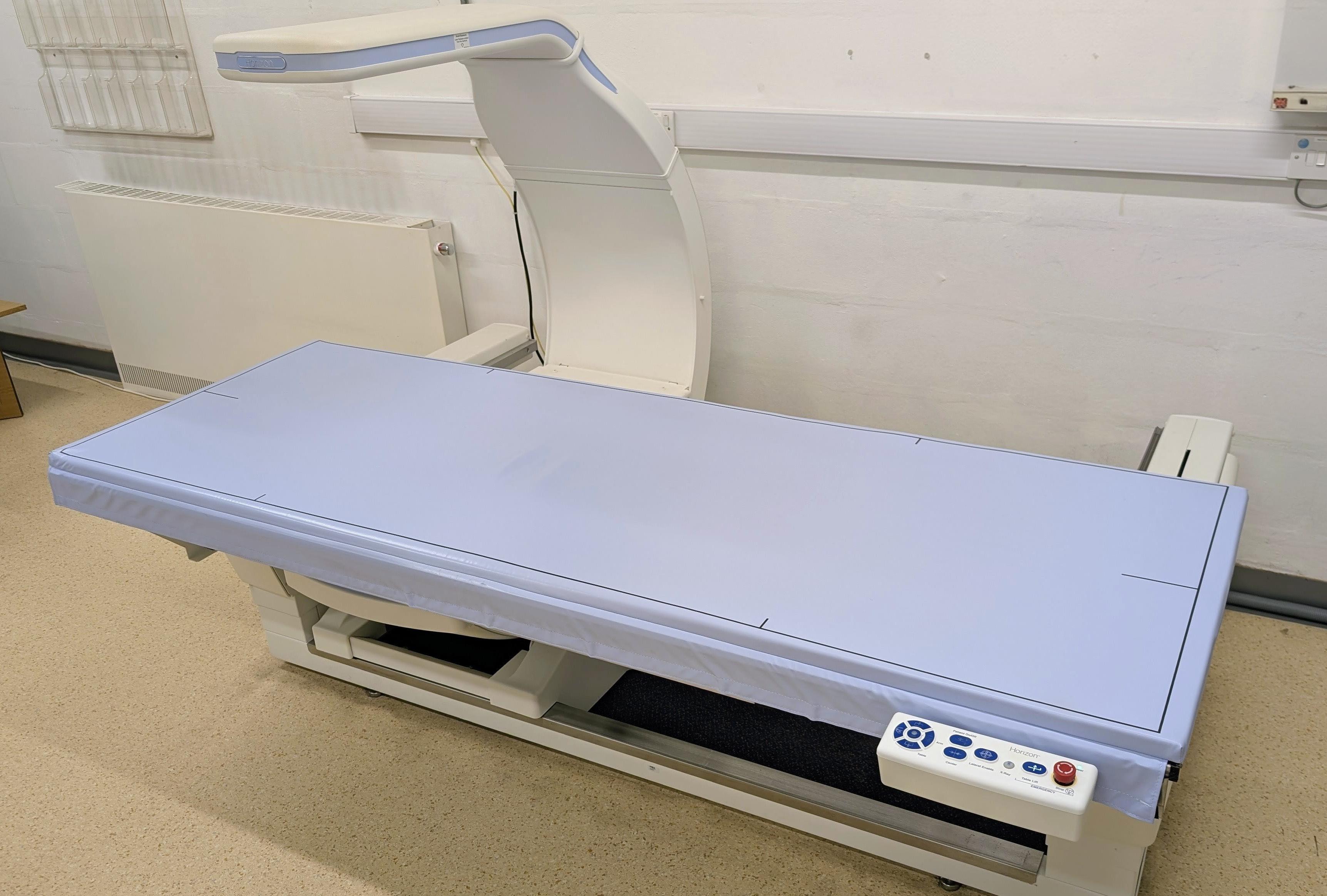
We have two Hologic Horizon bone densitometers for clinical DXA scanning and access to a high-resolution peripheral quantitative computed tomography (HRpQCT) scanner for assessing bone micro-architecture in research, as well as experience in radiofrequency echographic multi-spectrometry, REMS.
What is osteoporosis?
Osteoporosis is a condition where bones lose strength, making you more likely to break a bone. These breaks can occur quite easily, for example after a minor bump or fall and are most likely to occur in the spine, hip and wrist.
A diagnosis of osteoporosis doesn't mean you will definitely break a bone. But it does mean you are at higher risk of a broken bone than the average person.
Osteoporosis can be diagnosed by having a bone density scan. It is a quick and painless scan using a special type of x-ray technology called dual energy x-ray absorptiometry (DXA).
Having a DXA scan
A DXA scan appointment will take approximately 20 minutes, and you will lie on the scanning table for scans of your spine and hips. There are no injections involved, and you do not have to go into a tunnel.
You do not have to undress, as long as there are no metal fastenings, such as zips or metal buttons, in the area to be scanned.
DXA scans use a very low dose of x-ray and are very safe, however if there is any chance of pregnancy, please contact us for advice as soon as you receive your appointment letter. There is a slight risk that x-ray exposure could harm a developing baby.
Find out more about bone density scans on the NHS website.
Booking a DXA scan
Most DXA scans are scheduled through a referral, and appointment letters and texts are sent to patients.
DXA scans have an NHS diagnostic target of six weeks from the time we receive the referral. We take pride in offering most appointments within this time frame.
Because of this target, we typically experience few cancellations and encourage everyone to attend whenever possible.
If you are unable to attend the appointment we have scheduled for you, please reach out to our friendly reception team using the contact details provided below.
Please be aware: If you do not arrive for your appointment, it will be marked as DNA, and the referral will be closed and returned to your GP or consultant.
You can also enquire about scheduling a private scan, subject to availability. The cost of the scan is £125 and is payable by cash on the day. If the cost is covered by your private medical insurance, we will need your insurance details and the claim reference number.
Find us
The osteoporosis centre is located on C level, West Wing. You can ask at the hospital main reception who can provide directions. Alternatively, you can see our map and directions below.
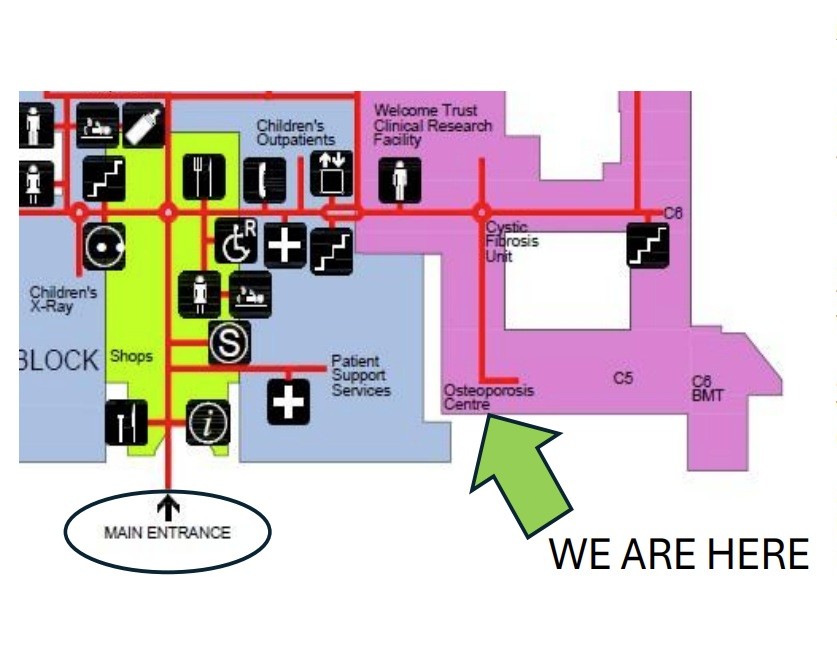
Directions from the main entrance
- Continue along the main corridor past the shops until you reach the T-junction at the end (M&S cafe).
- Turn right at the cafe.
- Follow the corridor past the lifts and follow signs for 'West Wing level C wards C5, C6, C7...'
- Turn right at the sign that reads 'Ward C5, Cystic Fibrosis outpatients, Osteoporosis centre'.
- The osteoporosis centre reception is at the bottom of the narrow corridor on the right side.
Contact us
Call us on 023 8120 4696 (9am to 4pm)
Email osteoporosis@uhs.nhs.uk